Redesigning Transocean’s deep sea control system for safety and efficiency
Transocean was engineering an entirely new subsea control system for their rigs that drill up to 10,000 feet underwater. As they changed the mechanical technology that had been in use for over 80 years, the human-machine interface needed to change, too.
We delivered a solution that was not only easier to use for old-school 25-year veteran drillers, it helped them to understand and learn how brand new subsea technology worked.
CONTEXT
The system that Transocean was redesigning was to replace the same system that failed in the Deepwater Horizon accident in the Gulf of Mexico. Not only does downtime caused by user error cost them millions, preventing accidents thru user error is what keeps their crews and the environment safe.
Our challenge was to design a new HMI that is usable and efficient, despite new underlying mechanics underneath, can we reduce downtime for the rig and increase safety for the crew?
WHAT WE MEASURED
Usability scores using System Usability Scale (SUS)
Comprehension of how the new mechanical system works
Through several rounds of usability testing during development, and including drillers across a wide range of experience, we reached a usability score in the 97th percentile on the System Usability Scale, and a patented new system interface design.
OUTCOME
Turning data overload into situational awareness
The new mechanical system created a lot more data than previous systems. That was both a great opportunity, and a challenge—how to balance situational awareness without increasing cognitive overload. This new information was also a hurdle for new users to get onboarded and understand how the mechanical system actually worked.
Our solution used a hierarchical navigation that bubbled up key information and allowed for users to drill down into more details only when needed. All of this was presented through consistent, clear visualizations that quickly informed users what was normal—and what was in need of attention.
Understanding culture helped to ensure acceptance
Our team’s initial on-site research—in this case, a few days on a rig in the Gulf of Mexico—helped shape our view of the culture on the rig. It is a close-knit group of workers who live in close quarters for extended periods. Due to the inherent danger of working on a rig, this leads to deeper trust amongst colleagues than in most work environments.
Our broader understanding of culture, communication, and experience helped us throughout the process. We not only needed to understand their processes and rules, but we also worked closely with drillers and engineers as subject matter experts in the co-creation of the solution.
This entire approach from understanding to co-creation to testing ensured that we could design something that not only met the technical requirements and standards, but would be accepted and embraced by the men and women on a rig.
HOW WE DID IT
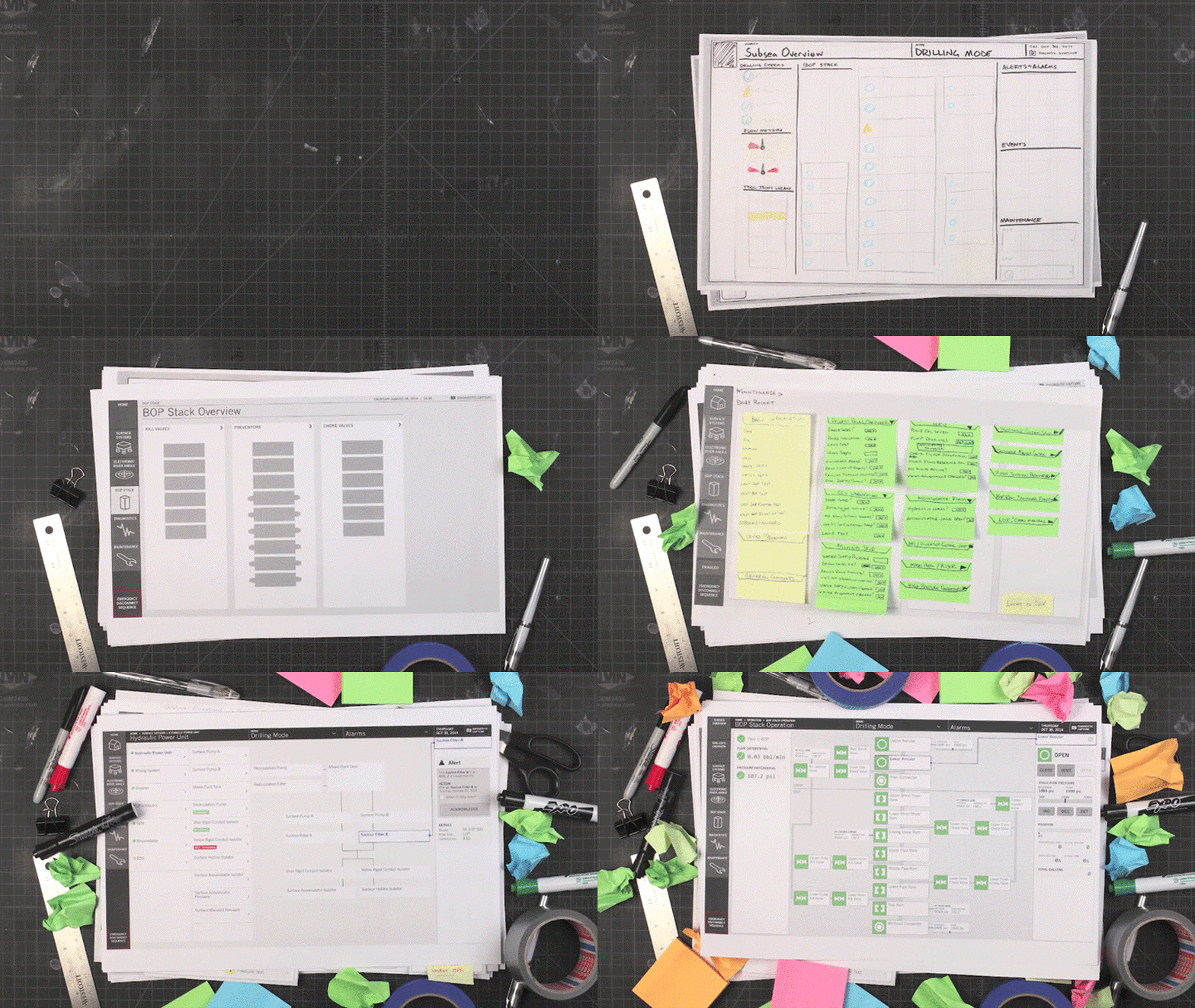
Turn drillers into power users on day one
The systems that drillers use are complex, and that’s because they are powerful. Keeping a rig accurately located over a well that’s a mile or more below them on the ocean floor while also monitoring many different systems onboard to avoid downtime is no small feat. Because of this, they go through training and certification twice a year.
Our team built on this institutional knowledge and familiarity with existing systems to introduce new concepts. We did this by improving their expected system design patterns with more robust, proven UX patterns and better information architecture.
This resulted in accelerated understanding of how the system worked, best-in-class usability scores, and remarkable user confidence after using it for the first time.